
As one of the largest pallet manufacturers and recyclers in the United States, we field a lot of questions from supply chain managers and sustainability professionals looking to lower their environmental footprint. One of the most common questions we hear at Kamps is ” How does pallet recycling exactly lead to carbon avoidance?”
As corporations increasingly focus on their environmental sustainability goals, understanding the life cycle of your shipping materials is critical. The short answer to the question of “how does wooden pallet recycling lead to carbon avoidance” is that pallet recycling keeps existing wood in circulation longer, reduces the need for new lumber, and diverts wood waste from landfills.
However, to fully understand the impact, it is important to break down the science, process, and numbers behind carbon avoidance in the wooden pallet industry.
What is Carbon Avoidance?
Carbon Direct, a climate and energy advisory firm, defines carbon avoidance as: “an action that prevents carbon-emitting activity from happening“. Carbon avoidance differs from reduction, which is defined as an action that decreases the amount of greenhouse gas emission of an existing activity. For example, investing in an electric fleet to transport goods would be considered carbon reduction as the same action of transporting goods utilizing trucks is occurring – just with a much lower (or zero) carbon emissions.
When applied to wooden pallets, carbon avoidance is achieved in two primary ways:
Preventing New Emissions
The carbon emitted during the process of repairing or recycling a wooden pallet is significantly lower than the energy-intensive process of harvesting, milling, transporting, and assembling virgin lumber for a brand-new pallet. This claim is supported by the UL certified Wooden Pallets Environmental Product Declaration.
Carbon Sequestration & Landfill Diversion
Trees naturally absorb carbon dioxide. When a tree is turned into a pallet, that carbon remains locked inside the wood. If a broken pallet is thrown into a landfill, it decomposes and releases methane—a potent greenhouse gas. By rescuing these pallets, we keep that carbon sequestered and avoid harmful landfill emissions. This claim is supported by the EPA’s Waste Reduction (WARM) model.
Combining Both for Greater Impact
Carbon reduction in the wooden pallets sphere can also be layered on top of these two examples if the pallet recycler invests in methods of lowering the carbon footprint of the activities that take place within the pallet recycling process. These practices can be investing in electric vehicles or powering the recycler’s facilities with renewable energy—such as solar and others.
At Kamps, our Comprehensive Pallet Life-Cycle Services™ (CPLS™) are designed to specificially to maximize these environmental benefits.
The 3 Ways Kamps Drives Carbon Avoidance
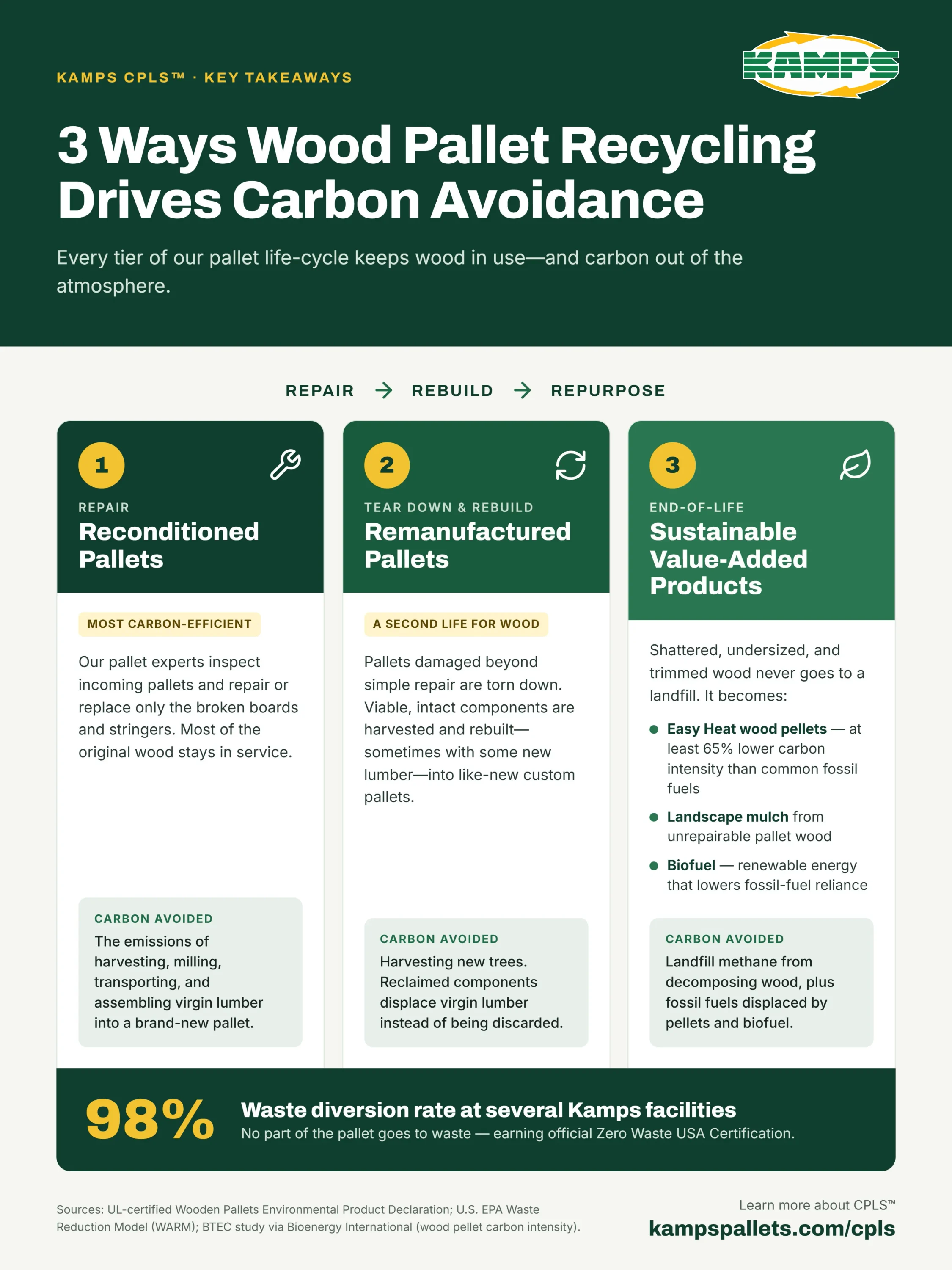
Our sustainable pallet life-cycle ensures that every piece of wood is utilized to its absolute highest potential. We achieve this through three specific tiers of pallet recycling.
Reconditioned Pallets (Repair)
The most carbon-efficient way to recycle a pallet is to fix it. When pallets arrive at our facilities, our pallet experts inspect and repair them by replacing or repairing broken boards or stringers. Because the vast majority of the pallet’s original material is preserved, the carbon footprint of a reconditioned pallet is minimal. This simple act of extending a pallet’s lifespan drastically avoids the carbon emissions associated with building a new one.
Remanufactured Pallets (Tear Down and Rebuild)
When a pallet is damaged beyond simple repair, it doesn’t mean that the entire pallet is useless. Through our remanufacturing process, we tear down unusable pallets and harvest the viable, intact components. We then use these reclaimed materials, sometimes in combination with new lumber, to build “like-new” custom pallets. Remanufactured pallets give a second life to wood components that would otherwise be discarded, which directly displaces the need to harvest new trees.
Sustainable Value-Added Products (End-of-Life)
What happens to wood components that are completely shattered, too small to be used in a remanufactured pallet, or are residuals of cutting down used components to size? This is where Kamps’ commitment to zero-waste truly shines. Instead of sending wood scrap to a landfill, we convert it into what we call Sustainable Value-Added products.
Our Environmentally friendly “End-of-Life” disposal processes turn scrap wood into:
- Easy Heat Wood Pellets: We process scrap wood into premium wood heating pellets. Research shows that because our pellets are manufactured from recycled sources, they boast at least a 65% reduction in carbon intensity compared to common fossil-derived fuel sources.
- Landscape Mulch: We grind unrepairable pallet wood into high-quality mulch, preventing thousands of metric tons of CO2-equivalent greenhouse gases from entering the atmosphere.
- Biofuel: Wood waste is repurposed as renewable green energy, lowering our reliance on traditional fossil fuels.
By ensuring that no part of the pallet goes to waste, we are actively practicing landfill avoidance. In fact, several of our facilities have even achieved a 98% waste diversion rate, earning official Zero Waste USA Certification.
To learn more about Kamps’ overall environmental impact, click here to download our latest Corporate Social Responsibility report.
3 Ways Wood Pallet Recycling Drives Carbon Avoidance Takeaway (Click on image to download PDF takeaway)
Improve Your Supply Chain’s Sustainability With Kamps
Pallet recycling is no longer just a way to cut costs, it is a critical strategy for lowering your organization’s carbon footprint. Every time you choose to buy reconditioned pallets, utilize remanufactured pallets, or partner with a recycler to handle your wood waste, you are actively participating in carbon avoidance.
At Kamps, we believe that waste is simply a resource in the wrong place. If you are looking for a pallet provider who can deliver both economic value and concrete environmental data to support your corporate sustainability goals, our team is ready to help.
